The 2026 regulatory landscape for digital privacy
By 2026, the legal environment surrounding digital privacy has shifted from a debate over data protection to an active campaign against the tools used to bypass state-imposed restrictions. Governments in the European Union, Russia, and various Middle Eastern jurisdictions are increasingly criminalizing the possession and distribution of circumvention technologies. This legislative hardening signals that censorship resistance is no longer a technical niche but a high-stakes legal battleground.
In the European Union, regulatory pressure has intensified following reports from the House Judiciary Committee. A February 2026 analysis highlighted that resistance to censorship efforts by regulatory bodies is now met with severe retaliatory measures. The committee’s findings suggest that the EU is moving toward stricter enforcement mechanisms, treating the use of privacy-enhancing tools not as a user right, but as a potential violation of digital sovereignty laws. This marks a significant departure from earlier frameworks that prioritized open internet access.
Meanwhile, Russia has expanded its existing internet sovereignty laws to target decentralized protocols more aggressively. Authorities are focusing on blocking peer-to-peer networks and encrypting communications that fall outside state-monitored channels. Similarly, Middle Eastern nations have implemented new filtering mandates that require internet service providers to actively detect and disrupt anonymizing traffic. These coordinated efforts across distinct jurisdictions reflect a global move toward tighter control over digital information flows.
The cumulative effect of these policies is a shrinking space for uncensored communication. As legal risks increase, the burden shifts to users to understand the specific prohibitions in their region. Compliance is becoming increasingly difficult for both service providers and end-users alike, setting the stage for a new era of digital enforcement.
Government crackdowns on circumvention tools
Regulatory enforcement against digital privacy tools has intensified significantly across major jurisdictions in 2025 and 2026. Governments are moving beyond passive monitoring to active prohibition, targeting both commercial VPN providers and decentralized network protocols. This shift reflects a broader strategy to maintain information control in an increasingly interconnected digital environment.
Europe: Regulatory Retaliation
In February 2026, the U.S. House Judiciary Committee released a report detailing the "foreign censorship threat," specifically highlighting Europe's evolving stance. The analysis suggests that the European Commission is preparing to meet resistance to its censorship efforts with severe regulatory retaliation. This indicates a hardening of policy where circumvention tools are viewed not as consumer utilities, but as instruments of foreign interference. The regulatory landscape in the EU is shifting from data protection to active suppression of unmonitored traffic.
Russia: Internet Blackouts
Russia has implemented some of the most aggressive measures against circumvention tools in 2026. According to Mediazona, millions of Russian citizens now face internet blackouts and broken payment systems as part of a broader isolation strategy. The state has systematically restricted access to the outside web, forcing users into a shrinking set of approved tools. Enforcement mechanisms include deep packet inspection and mandatory ISP compliance, making the use of unauthorized VPNs or decentralized networks increasingly difficult and risky.
Middle East: Broad Bans
Countries in the Middle East have joined the global trend of banning VPNs and decentralized networks. Reports from 2025 and 2026 indicate that nations in the region are actively blocking access to privacy-focused services like Nym. The enforcement mechanisms vary from technical blocking at the ISP level to legal penalties for users and providers. This coordinated regional effort aims to prevent citizens from bypassing state-imposed content filters and surveillance systems.
The convergence of these regulatory actions across the EU, Russia, and the Middle East signals a new era of digital sovereignty. As states prioritize control over openness, the tools designed to resist censorship face unprecedented legal and technical challenges. Regulatory bodies are increasingly willing to use legislative force to dismantle decentralized privacy infrastructure.
Technical and Legal Distinctions in Decentralized Networks
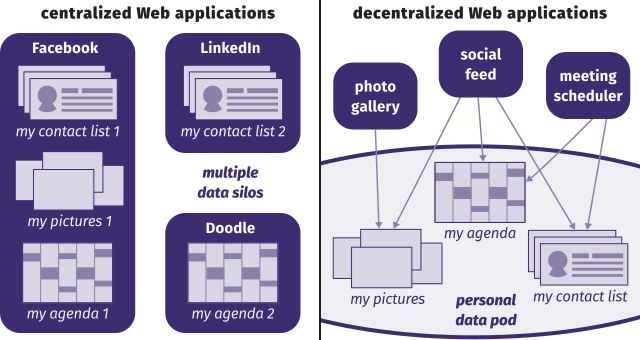
The architectural foundation of public permissionless blockchains differs fundamentally from centralized platforms, creating distinct regulatory liabilities. As noted in a February 2025 analysis by the New York Fed, these networks are engineered to ensure that access to the blockchain remains unhampered by any single entity. This design principle, often termed censorship resistance, means that no central authority can unilaterally prevent participants from joining the network or executing transactions. In contrast, centralized platforms operate under explicit terms of service that allow for immediate account suspension and content removal, a mechanism frequently leveraged by governments in jurisdictions such as the EU and Russia to enforce local compliance.
From a legal perspective, this technical distinction shifts the locus of control. Centralized platforms act as intermediaries that can be compelled to censor under laws like the EU’s Digital Services Act. Decentralized systems, however, distribute this control across a global network of nodes. While this does not make transactions anonymous, it removes the central choke point that regulators typically target. Authorities in the Middle East and elsewhere are increasingly focusing on the on-ramps and off-ramps—centralized exchanges—rather than the underlying protocol, precisely because the protocol itself resists centralized intervention.
This inherent resistance is not absolute but structural. It relies on the economic and computational cost of attacking the network rather than legal enforcement against a single company. For users and developers in 2025 and 2026, understanding this difference is critical for navigating compliance. While centralized services must adhere to strict KYC/AML requirements enforced by national regulators, decentralized protocols often exist in a gray area where enforcement is technically difficult and legally ambiguous. This structural resilience offers a layer of protection that centralized platforms simply cannot provide, making decentralization a key consideration for applications requiring high availability and resistance to state-level pressure.
Web3 applications in high-risk environments
As geopolitical tensions escalate in 2025 and 2026, the utility of decentralized technologies has shifted from speculative finance to critical infrastructure. In jurisdictions such as Russia and parts of the Middle East, where internet infrastructure is increasingly subject to state-level throttling and blocking, Web3 applications offer essential alternatives for communication and identity management. Analysis suggests that these tools are no longer niche experiments but vital components of digital resilience for populations facing censorship.
Decentralized communication protocols enable users to bypass regional internet service provider (ISP) blocks that often target centralized platforms like Telegram or WhatsApp. By routing data through distributed nodes, these applications maintain connectivity even when national firewalls are active. This architectural resilience is particularly evident in wartime scenarios, where reliable coordination depends on uninterrupted access to information. The following diagram illustrates how decentralized networks maintain connectivity despite regional ISP blocks.
Beyond communication, resilient identity management has become a priority for displaced populations in the EU and conflict zones. Traditional digital identity systems are vulnerable to seizure or deletion by authoritarian regimes. Blockchain-based identity solutions allow individuals to retain control over their credentials, ensuring that personal data remains accessible regardless of political instability. While the EU is developing frameworks for digital identity verification, the underlying decentralized nature of these tools provides a layer of protection that centralized databases cannot match.
Compliance Checklist for Decentralized Projects
As regulatory frameworks harden in 2025 and 2026, decentralized projects face increasing pressure to demonstrate technical resilience against state-level censorship. Analysis of recent legislative trends in the EU, Russia, and the Middle East suggests that purely technical anonymity is no longer sufficient for legal safety. Projects must now integrate compliance into their operational architecture to mitigate liability.
The following checklist outlines essential steps for developers and operators to assess their exposure. These measures are derived from observed enforcement patterns in restrictive jurisdictions rather than universal legal statutes.
Technical and Operational Resilience
- Decentralized Infrastructure Audit: Ensure that node distribution and data storage do not rely on centralized cloud providers subject to sudden subpoena or shutdown orders in high-risk jurisdictions.
- Code Obfuscation and Forkability: Maintain clear, documented pathways for community forks. If a primary interface is blocked by regional ISPs, the underlying protocol must remain accessible and verifiable by independent clients.
- Transaction Privacy Defaults: In jurisdictions with strict capital controls or internet filtering, consider implementing privacy-preserving protocols by default to prevent transaction metadata from being used as evidence of non-compliance.
Legal and Governance Preparedness
- Jurisdictional Entity Separation: Clearly separate the legal entity managing the project from the decentralized protocol itself. Authorities target the operating entity, not the code, making this distinction critical for asset protection.
- Community Governance Transparency: Maintain public records of governance votes and protocol upgrades. This transparency can serve as evidence that the protocol is community-driven, potentially shielding individual developers from liability for specific user actions.
- Regulatory Monitoring: Establish a dedicated function to monitor legislative changes in key markets, particularly the EU’s MiCA implementation and evolving censorship laws in Russia and the Middle East. Early detection of regulatory shifts allows for proactive technical adjustments.
Common Questions About Censorship Resistance
As regulatory frameworks evolve across the EU, Russia, and the Middle East during 2025-2026, understanding the mechanics of censorship resistance is essential for legal compliance and network integrity.
No comments yet. Be the first to share your thoughts!