Defining the 2026 censorship landscape
The year 2026 marks a distinct shift in how artificial intelligence intersects with content moderation. The global environment is no longer defined by a single model of control but by a bifurcation between state-mandated AI filtering and private platform safety systems. Understanding this distinction is critical for analyzing the current regulatory trends.
In authoritarian jurisdictions, AI has become the primary engine for information control. China’s approach, described by the Carnegie Endowment for International Peace as "AI-empowered censorship," integrates powerful language models directly into public and private domain filtering. This system allows for real-time, large-scale enforcement of state directives, moving beyond keyword blocking to semantic understanding of intent and context. Similarly, Russia’s Roskomnadzor has announced plans for a 2.27 billion ruble AI-based censorship framework to launch in 2026, aiming to automate the restriction of online content across the nation’s digital infrastructure.
In contrast, Western nations rely heavily on private platform moderation, often guided by voluntary safety standards and emerging regulatory frameworks like the EU AI Act. However, the definition of "censorship" in these regions is often contested. Industry observers note that Western AI models may face stricter content restrictions than their Chinese counterparts, particularly regarding hate speech, misinformation, and political neutrality. This divergence highlights a complex geopolitical landscape where the mechanisms of control differ significantly, even if the outcome—restricted information flow—is sometimes similar.
This article analyzes regulatory frameworks and model behaviors as of early 2026. It does not provide legal advice.
Compliance may require organizations to navigate these differing standards depending on their operational jurisdictions. The trend suggests that AI will continue to be the central tool for both enforcing state ideology and managing private platform liability.
State Laws and Deepfake Regulations
The regulatory landscape for artificial intelligence shifted decisively in 2026, moving from theoretical frameworks to active enforcement. While the European Union’s AI Act began enforcing high-risk requirements in August, the United States saw a surge in state-level legislation targeting specific harms. This fragmentation creates a complex compliance environment for content creators, where legal risks vary significantly by jurisdiction.
US State-Level Expansion
By early 2026, more than fifteen US states had enacted new AI regulations, with a heavy focus on deepfake prevention. These laws primarily target two areas: sexual non-consensual imagery and political misinformation. States like Colorado and Virginia have implemented strict disclosure requirements for AI-generated political ads, mandating clear labeling to protect electoral integrity. For content creators, this means that standard production workflows may now require additional metadata tagging or explicit disclaimers to remain compliant.
The expansion of these laws reflects a broader trend toward granular, issue-specific regulation rather than broad federal oversight. This approach allows states to address local concerns but complicates nationwide distribution for digital media companies.
EU AI Act Enforcement
Simultaneously, the European Union entered the enforcement phase of the AI Act. The legislation’s high-risk classification triggers rigorous obligations for developers and deployers of certain AI systems. Compliance may require detailed technical documentation, human oversight mechanisms, and robust data governance practices. For global platforms, this means adapting their content moderation and generation tools to meet stricter transparency standards than those currently required in most US states.

The divergence between US state laws and EU federal regulations highlights the increasing difficulty of maintaining a unified global content strategy. Organizations operating across these jurisdictions must now navigate a patchwork of disclosure rules, liability standards, and enforcement timelines.
Key Enforcement Dates
The following timeline outlines critical enforcement milestones for 2026, helping stakeholders anticipate regulatory pressure points.
Model refusal rates and bias
In 2026, the variance in how AI models handle sensitive queries remains significant, reflecting divergent approaches to safety and compliance. Research indicates that strictness is not uniform across providers, with some platforms prioritizing broad content filtering while others adopt more permissive boundaries for specific use cases.
According to an analysis by Eye2.ai, which tested over ten models in 2026, Claude and Amazon Nova exhibited the highest refusal rates for standard safety boundary prompts. In contrast, Grok and Llama demonstrated the lowest refusal rates, suggesting a different calibration of risk tolerance. This disparity highlights the ongoing tension between regulatory pressure and operational flexibility in AI development.
The following table compares the observed refusal behaviors of major models against common sensitive categories. These figures are derived from standardized testing protocols applied in early 2026.
| Model | Refusal Rate (Standard Safety) | Strictness Level |
|---|---|---|
| Claude | High | Strict |
| Amazon Nova | High | Strict |
| Grok | Low | Permissive |
| Llama | Low | Permissive |
Decentralized social media alternatives
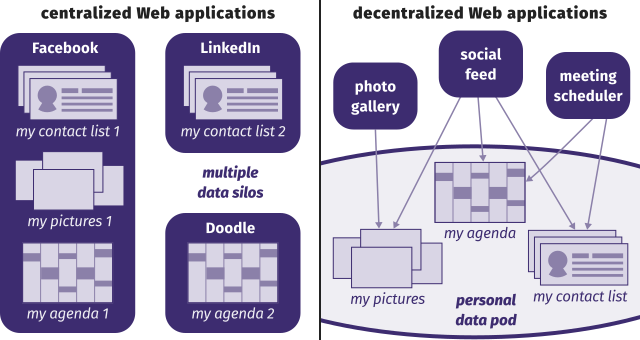
Centralized platforms increasingly rely on AI-driven content moderation to enforce compliance with evolving state regulations. In response, decentralized social media protocols are gaining traction as architectural alternatives that remove single points of control. These systems shift censorship resistance from policy enforcement to cryptographic verification, ensuring that content remains accessible regardless of jurisdictional pressure.
The core mechanism involves storing social graph data and posts across distributed networks rather than private servers. For instance, the Nostr protocol uses a publish-subscribe model where any node can relay messages. While this does not prevent nodes from choosing to filter content, it prevents any single entity from deleting history or silencing users globally. Similarly, decentralized alternatives like Bluesky utilize the AT Protocol, which allows users to port their identity and social connections between different client applications and moderation providers.
This fragmentation of moderation creates a "choice of law" dynamic. Users can select clients that align with their preferred speech standards, whether that involves strict adherence to local laws or minimal intervention. However, this model also introduces challenges in coordinating against coordinated abuse or illegal content without centralized oversight. As regulatory frameworks like the EU’s Digital Services Act tighten compliance requirements for intermediaries, the legal liability of decentralized node operators remains an evolving area of analysis.
The shift toward decentralized infrastructure suggests a future where speech governance is fragmented rather than uniform. This trend complicates regulatory enforcement, as authorities may find it difficult to mandate content removal across a network with no central administrator. Legal frameworks are currently adapting to these technical realities, with some jurisdictions exploring liability models for node operators while others focus on regulating the endpoints where users access the network.
Compliance checklist for publishers
As regulatory frameworks solidify in 2026, publishers face a fragmented but accelerating compliance landscape. The EU AI Act’s high-risk requirements took effect in August, while over fifteen US states have enacted their own AI-specific statutes since 2024 [[src-serp-8]]. Navigating these obligations requires a systematic approach to content governance, labeling, and data provenance.
Compliance may require distinct strategies for different jurisdictions. The following steps outline the core operational adjustments publishers should implement to align with current legal expectations.
Identify which AI-generated content falls under high-risk classifications in your primary markets. The EU AI Act explicitly targets deepfake generation and synthetic media used in political or commercial contexts [[src-serp-8]]. Documenting these workflows helps establish due diligence if enforcement actions arise.

Most new state laws and federal guidelines now require clear disclosure of AI-generated content. This includes watermarks, metadata tags, and visible disclaimers on published pages. Failure to label synthetic media can trigger penalties under emerging state deepfake statutes [[src-serp-7]].
Maintain verifiable logs of training data sources and generation prompts. Regulatory trends suggest that transparency in data sourcing will become a primary metric for compliance audits. Keep records accessible for at least three years to satisfy potential regulatory inquiries.

State-level laws in the US vary significantly, particularly regarding sexual deepfakes and political election integrity. Monitor legislative updates in each state where you distribute content, as enforcement priorities differ by region [[src-serp-7]].
Common questions on AI censorship
Regulatory trends suggest that AI compliance is shifting from voluntary guidelines to enforceable state laws. As of 2026, several states have enacted deepfake restrictions targeting sexual exploitation and political misinformation. Compliance may require content platforms to implement robust labeling systems for AI-generated media, particularly in jurisdictions like California and New York where enforcement is active.
Technical censorship varies significantly across model providers. Independent testing in early 2026 indicates that models like Claude and Amazon Nova maintain stricter refusal rates for sensitive topics compared to open-weight models like Llama. This divergence creates a complex landscape for developers who must navigate different safety filters depending on the underlying architecture.
No comments yet. Be the first to share your thoughts!