
DAG vs Leader Consensus Censorship Resistance in Blockchain Sequencing 2026

In the high-stakes arena of blockchain sequencing for 2026, the tension between Directed Acyclic Graph (DAG)-based protocols and traditional leader consensus mechanisms boils down to one critical factor: censorship resistance. As global finance pivots toward decentralized systems, leader-based chains like Solana grapple with inherent bottlenecks, where a single proposer’s vulnerability can halt progress or enable targeted suppression. Leaderless DAGs, championed by projects like Fides and Avalanche, promise unbounded resilience by distributing authority across the network, a shift ChainScore Labs deems inevitable for scalable, uncensorable finance.

Leader Consensus: A Single Point of Fragility in Sequencing
Leader-based consensus, powering chains such as Cosmos and Binance Smart Chain, relies on a designated proposer to sequence transactions and advance the chain. This model, rooted in protocols like Tendermint and HotStuff, delivers deterministic finality but at a steep cost: liveness hinges on one node’s availability. If the leader faces censorship, outage, or malice, the entire network stalls, sacrificing availability for finality. Historical downtimes in Proof-of-Stake ecosystems underscore this flaw; validators sets have crumbled under pressure, exposing networks to regulatory chokepoints.
Consider the mechanics: in leader consensus blockchain sequencing, the proposer bundles transactions into blocks, broadcasts for validation, and awaits quorum. Delays here ripple outward, throttling throughput. Aptos Labs notes that even efficient designs economize leader bandwidth, yet consensus delays still inflate latency without boosting average output. This centralization invites censorship resistant transaction sequencing failures, as adversaries need only target the leader slot rotation.
Leader vs. DAG Consensus: Censorship Resistance and Performance Metrics (2026)
| Metric | Leader-Based Consensus (e.g., Tendermint, HotStuff, Solana) | DAG-Based Consensus (e.g., Avalanche, Fides) |
|---|---|---|
| Censorship Resistance | Low 🚫: Single point of failure; leader offline/censored causes liveness failures (e.g., Cosmos/BSC downtimes) [ChainScore Labs] | High ✅: No single leader; parallel proposals enhance resilience [arXiv SoK, Fides] |
| Throughput | Limited: Bottlenecks from leader bandwidth [ChainScore Labs, Aptos Labs] | High: Concurrent block production, unbounded scalability [arXiv SoK, Aptos Labs] |
| Latency | Higher: Leader delays impact consensus [Aptos Labs] | Low: Parallel processing minimizes delays [Avalanche, Fides] |
| Scalability to Validators | Limited: Struggles with large validator sets [ChainScore Labs] | High: Scales to hundreds of validators [Obelia, Alberto Sonnino] |
Structured DAGs attempt mitigation but falter under scale, as Alberto Sonnino’s work on Obelia reveals, struggling beyond hundreds of validators without hybrid tweaks.
DAG Protocols: Parallel Power Against Censorship
DAG-based consensus flips the script, enabling concurrent block production sans leaders. Protocols like Fides and Avalanche allow nodes to propose transactions in parallel, weaving them into a graph where consensus emerges from topological order. This DAG consensus censorship resistance shines in adversarial settings; no single point invites attack. ArXiv’s SoK on DAG systems highlights parallel writing as the divergence from linear leader models, fostering higher throughput via simple rules over Byzantine Fault Tolerance complexity.
Fides, detailed in recent ResearchGate papers, integrates Trusted Execution Environments (TEEs) for scalable, secure operation, blending leaderless efficiency with BFT guarantees. Cryptology ePrint Archive emphasizes how DAG BFT balances efforts across parties, sustaining high throughput amid failures. Obyte’s DAG vs blockchain comparison crystallizes this: DAGs excel in speed and resilience, sidestepping blockchain’s sequential chokeholds.
Sui’s Mysticeti production run, per International Financial Cryptography Association, validates leaderless fee mechanisms, surging DAG adoption. Yet caution tempers enthusiasm; TEE reliance in Fides risks enclave compromises, demanding rigorous audits.
Throughput and Liveness: Metrics Exposing the Divide
Quantitative edges define the leader consensus blockchain sequencing debate. Leader protocols cap at leader bandwidth limits, with delays hitting latency hard. DAGs decouple these, as Aptos’ mempool designs show: throughput holds steady despite hiccups. ChainScore Labs’ formal verification benchmarks leader systems as single points of failure, prone to liveness attacks absent perfect synchrony.
ACM’s SoK on DAG blockchains advocates Timestamp Agreement (TSA) simplicity, slashing consensus overhead for superior scalability. Angelfish hybrids adapt from leader to pure DAG, smoothing transitions while preserving censorship resistance. In 2026’s updated landscape, DAGs like Obelia scale to validator hordes, outpacing structured predecessors.
Solana Technical Analysis Chart
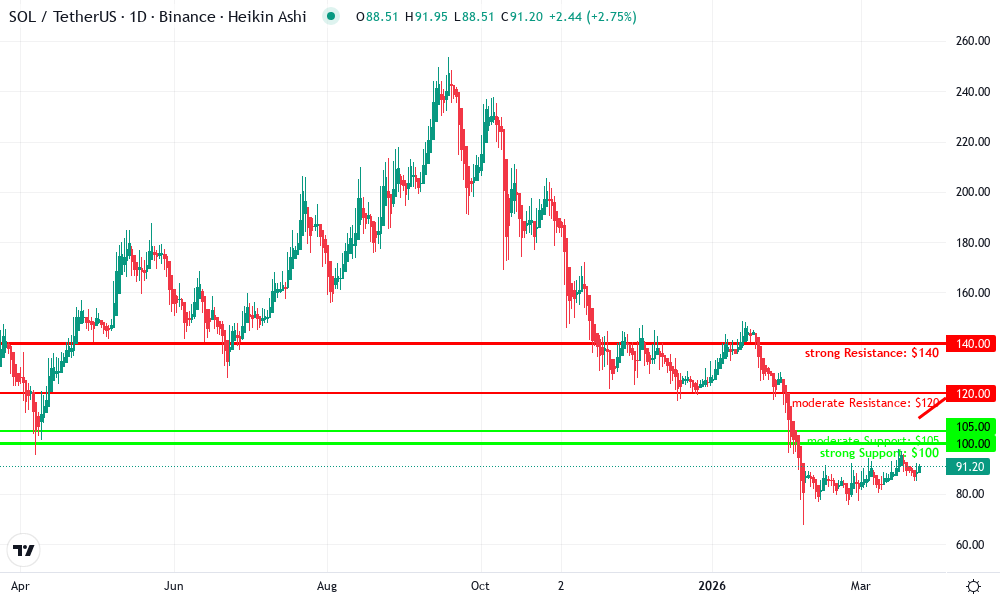
Analysis by John Smith | Symbol: BINANCE:SOLUSDT | Interval: 1D | Drawings: 6
Technical Analysis Summary
As John Smith, CFA with 15 years in DeFi liquidity analysis, I recommend drawing a primary downtrend line connecting the swing high at 2026-09-15 around $240 to the recent low at 2026-03-20 around $105, using ‘trend_line’ tool in red. Add horizontal support at $100 (strong) and resistance at $140 (moderate) with ‘horizontal_line’. Mark consolidation range from 2026-02-01 $130 to 2026-03-01 $115 using ‘rectangle’. Place arrow down at MACD bearish crossover on 2026-03-10 with ‘arrow_mark_down’. Use ‘text’ for notes on volume divergence. Entry zone long only above $120 with stop below $105, conservative per my low-risk style.
Risk Assessment: medium
Analysis: Downtrend intact but oversold with volume clues; fundamental DAG threats cap upside, low tolerance limits aggression
John Smith’s Recommendation: Hold cash or liquidity positions; enter longs conservatively above $115 with <2% risk, prioritize DeFi diversification away from leader-based chains
Key Support & Resistance Levels
📈 Support Levels:
-
$100 – Psychological support coinciding with prior lows, liquidity accumulation zone
strong -
$105 – Recent swing low, moderate hold
moderate
📉 Resistance Levels:
-
$120 – Immediate overhead from recent consolidation high
moderate -
$140 – Prior breakdown level, strong barrier amid DAG news flow
strong
Trading Zones (low risk tolerance)
🎯 Entry Zones:
-
$115 – Conservative long entry on volume pickup above support, low risk per fundamental liquidity thesis
low risk -
$125 – Secondary entry on resistance break, but only with tight stops
medium risk
🚪 Exit Zones:
-
$140 – Profit target at resistance
💰 profit target -
$98 – Stop loss below key support to protect capital
🛡️ stop loss
Technical Indicators Analysis
📊 Volume Analysis:
Pattern: decreasing on downside
Bearish divergence: price drops on low volume, suggesting weak selling pressure and potential base
📈 MACD Analysis:
Signal: bearish crossover
MACD line below signal since mid-March, confirming downtrend momentum
Applied TradingView Drawing Utilities
This chart analysis utilizes the following professional drawing tools:
Disclaimer: This technical analysis by John Smith is for educational purposes only and should not be considered as financial advice.
Trading involves risk, and you should always do your own research before making investment decisions.
Past performance does not guarantee future results. The analysis reflects the author’s personal methodology and risk tolerance (low).
This data-driven lens reveals DAG’s edge, but investors must weigh implementation risks. Privacy-focused chains demand not just speed, but unassailable sovereignty against surveillance.
Real-world pressures test these theoretical strengths, particularly in high-volume scenarios where censorship attempts spike. Solana’s repeated halts from leader overloads contrast sharply with Avalanche’s steady performance, where parallel processing absorbed 2025 surges without single-node dependency. This resilience underscores why blockchain consensus comparison 2026 tilts toward DAGs for mission-critical finance.
Case Studies: Censorship Events in the Wild
Examine Cosmos ecosystem outages: leader validator rotations faltered under targeted DoS attacks, delaying blocks by hours and enabling transaction censorship. Binance Smart Chain mirrored this, with proposer slots exploited for front-running, eroding trust in leader consensus blockchain sequencing. DAG counterparts fared better; Fides simulations in arXiv papers withstood 33% faulty nodes, maintaining liveness via distributed proposals. Aptos Labs’ mempool innovations further insulated against leader delays, prioritizing throughput over perfect synchrony.
Obyte’s side-by-side analysis drives the point home: DAGs achieve featherweight consensus without mining energy waste, ideal for censorship-prone regions. Yet, hybrids like Angelfish signal pragmatism, dialing leader elements for low-adversary environments while ramping DAG parallelism under duress. This adaptability positions them for 2026’s fragmented regulatory landscape.
Leaderless designs don’t just scale; they survive where chains break.
Investment Implications: Backing Unbreakable Foundations
As a portfolio manager turned decentralization advisor, I view DAG protocols through a risk-adjusted lens. Leader chains offer quick yields but court systemic fragility, vulnerable to the next validator purge or geopolitical squeeze. DAG assets, though nascent, embed censorship resistance into their DNA, aligning with long-term sovereignty. Consider validator scaling: Obelia’s advances push DAGs to hundreds of nodes without throughput collapse, per Sonnino’s benchmarks, outstripping Tendermint derivatives.
Sui’s Mysticeti rollout proves commercial viability, with fee mechanisms incentivizing honest parallelism over leader auctions. Transaction Fee Mechanism Design papers from the International Financial Cryptography Association forecast DAG dominance as projects like these mature. Investors should prioritize chains auditing TEE dependencies rigorously; Fides’ enclave reliance demands hardware diversity to avert Spectre-like pitfalls.
Portfolio allocation favors diversified exposure: 20-30% in pure DAG plays like Avalanche derivatives, balanced against hybrid explorers. Metrics guide entries; monitor TPS-latency ratios exceeding 10,000 with sub-1-second medians, hallmarks of production-ready DAG consensus censorship resistance. Avoid hype; substantiate with ChainScore Labs verifications.
Regulatory headwinds amplify this thesis. As governments eye transaction sequencing for compliance, leader models yield easily to subpoenas, while DAGs’ diffuse structure complicates enforcement. ChainScore Labs’ inevitability claim for leaderless finance resonates; global remittances and DeFi demand architectures defying borders and blacklists.
Challenges Ahead: Hardening DAG for Primetime
No panacea exists. DAGs grapple with ordering ambiguities, risking MEV extraction in parallel streams. Mysticeti counters via pipelined BFT, but finality lags leaders in optimistic cases. Scalability to thousands of validators requires novel gossip protocols, as Obelia hints. Security proofs remain partial; arXiv SoKs urge formal verification matching HotStuff’s maturity.
ACM’s TSA advocacy simplifies rules, yet timestamp wars persist in asynchronous nets. Hybrids like Angelfish bridge gaps, but purity suffers. Investors note: DAGs excel in adversity, not idyll. Benchmark under 50ms network diameters; falter beyond, and censorship creeps back.
2026’s horizon gleams with promise. Aptos’ vision of upgradable platforms accelerates iteration, embedding Aptos Jolteon censorship resistance as standard. Fides’ TEE fusion scales securely, per ResearchGate prototypes hitting 100k TPS. As surveillance tightens, these protocols fortify data sovereignty, empowering builders against centralized overreach.
Stake wisely in leaderless futures; fragility crumbles under scrutiny, but parallel resilience endures.